
Founder built
TrojanStrike
Permissioned attack simulation — attack yourself first. The marketing site is live; the strike engine is proprietary software in active development.
What we built — and where it's at
TrojanStrike is the marketing site for a proprietary attack-simulation engine currently in development. The product vision: prove domain ownership, enter one hostname, and a permissioned, rate-limited, read-only strike runs 56 checks across six escalation classes — with every request logged and streamed live. It renders one of four verdicts (INSIDE_THE_WIRE, BREACHED, AT_THE_DOOR, HELD) backed by the proving request, the impact and a concrete fix with a repro cURL. Recon is always free — and so is your first strike.
Verdicts, not scores
Every strike will end in one of four verdicts — no scores, no hedging. The build is Next.js with a stark, evidence-first design language: white ground, near-black display type, and a single violet accent reserved for status language. The homepage stages the strike as a scrolling four-phase narrative with a live lattice animation, and the Capabilities page commits to proof over promises — publishing benchmark scores and the misses. With the engine still in development, the site does the selling with the record it has already put on the table.
Details that matter
0 requests before attestation. '0 requests before attestation' — ownership is verified before any probe is sent. Recon is free, and so is your first strike.
Four verdicts, no scores. The verdict taxonomy is explicit four-state language: INSIDE_THE_WIRE, BREACHED, AT_THE_DOOR and HELD — one verdict per engagement, 'No scores, no hedging.'
Proof with every finding. Every finding ships with proof: the verdict, the proving request, the impact and the fix — including a repro cURL. The sample BOLA/IDOR finding (CWE-639) is published.
Benchmarks on record. The Capabilities page publishes benchmark scores on the record: OWASP BenchmarkJava 2,740 cases with 0 false positives, 26/26 Juice Shop and 16/16 WebGoat verdicts — misses published by name.
Four-phase strike narrative. A scrolling 'geometry of a strike' narrative walks through four phases — RECON, PROBE, STRIKE and VERDICT.
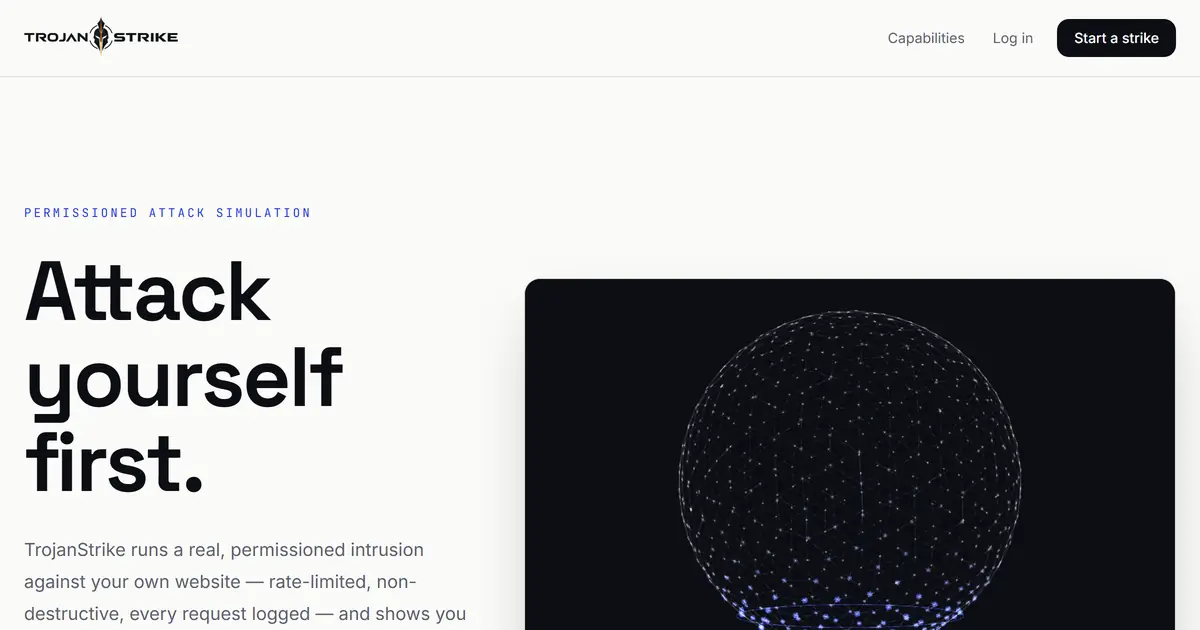
Live lattice hero. The hero renders a live status panel — 'CHECKS 56 · REQUESTS 4.6K · VERDICT PENDING' — over an animated lattice of nodes.
Published sample report. A full sample report is linked from the homepage at /sample-report, with /login and /strike routes behind the marketing page.
The proof ladder. The Capabilities page climbs a proof ladder — ground-truth benchmark, live owned targets, autonomous red-team grading — with false-alarm counts at each step.
Stack evidence: Next.js app — __next markers, immutable chunks, /_next/image device-picture-loader params.
How a strike works
Four steps. No black box.
Verify ownership
Prove the domain is yours. No attestation, no packets.
Enter target
One hostname — that's the whole setup.
The strike runs
56 attack & recon checks fire, rate-limited and read-only. The engine fingerprints your stack mid-scan and re-orders the surface to fit it.
Verdict + fix
Every strike ends in one of four verdicts — INSIDE_THE_WIRE, BREACHED, AT_THE_DOOR or HELD — with the evidence and the fix.
One client per industry, per area
Want this for your business?
Every build starts the same way: you describe it, we quote it fixed, and you see the finished design before you pay a cent.
Answered personally, same business day.