Founder built
The PuniCodex
An interactive atlas of the world's glyphs and the stories behind them — 983 restored names across 25 pantheons.
What we built
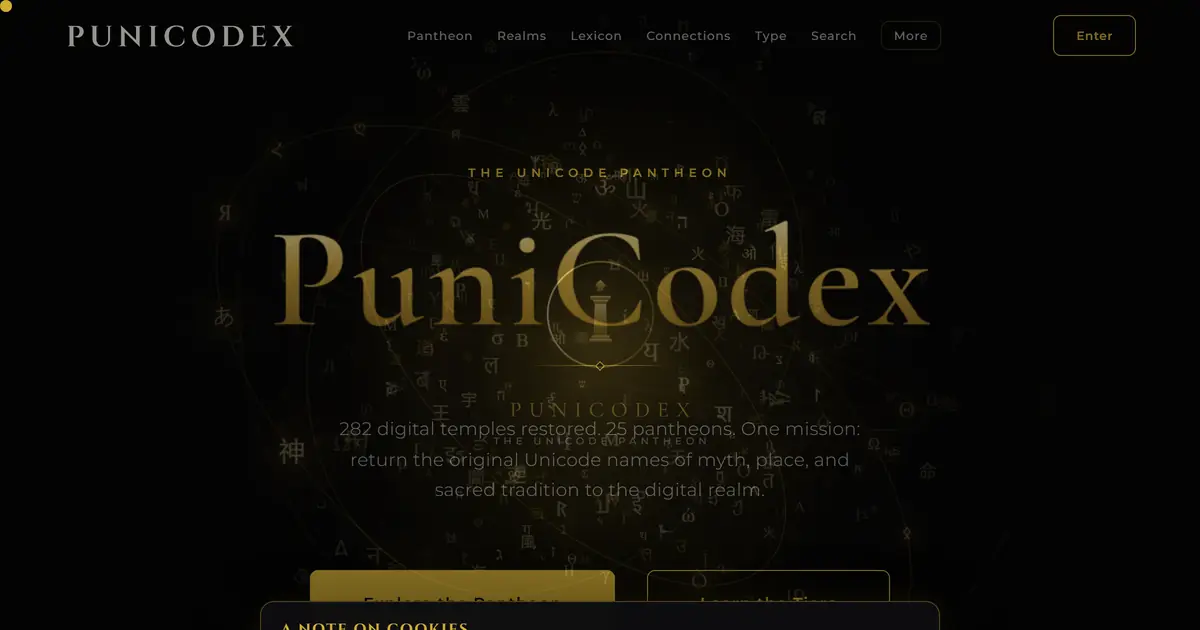
PuniCodex is a reference work rebuilt as a website: 983 mythological names restored to correct Unicode orthography across 25 pantheons, each with its own temple page carrying lore, gallery, a mora-by-mora pronunciation derived from a documented engine, and research citations. Around it sits a product ecosystem — a browser extension with an Authenticity anti-impersonation engine, an offline app with Shield verdicts, an Oracle quiz, and a per-temple sponsorship system with thirteen curated frames. The scale is the point: over 350 domain names intertwined into one interconnected pantheon — each temple its own world, and every name researched for its canonical transliteration before it earns a place.
Under the hood
Built as a hand-rolled static site — no framework fingerprints, just carefully versioned CSS and JS layers (motion system, cookie consent, analytics beacon) and structured data blocks. The design language is scholarly ritual: classical serif typography, antique gold on black, scattered scripts of many writing systems, and a temple metaphor that extends to the business model. Where lexica disagree, the interface shows both readings with citations — the dual tier is presented as the record itself, not an error.
Details that matter
983 temples. The Pantheon holds 983 temples across 25 pantheons, each restoring a mythological name to its true Unicode orthography.
Pronunciation engine. Each temple carries a machine-derived pronunciation guide — Árēs as 'AH-rays /ˈa.rɛːs/' — broken into morae with timing and articulation notes.
Disagreement on record. Where scholarship disagrees, the site records the disagreement instead of choosing: Hekatē (macron only) and Hekátē (stress and length) both stand on equal evidence.
Names as infrastructure. Names are treated as infrastructure: temple entries show the IDN punycode form and a 'Tier dual' classification, and the Authenticity engine judges impersonating lookalike domains.
Temples verified live. Individual temple pages verified live at /ares/, /odinn/, /quetzalcoatl/ and /amaterasu/ — lore, gallery, extended patterns, scholars and patrons each.
Lexica cited. Research citations surfaced in the interface itself — LSJ, Beekes — grounding transliteration choices in canonical lexica.
An ecosystem around it. An ecosystem around the pantheon: a browser extension with an Authenticity engine, an offline app with Shield verdicts, an Oracle quiz, and domain cards.
Sponsorship frames. Each of the 983 temples is a sponsorship property with thirteen curated frames — from 1200×400 banners to a manually reviewed full-page takeover.
Stack evidence: Hand-built static — versioned CSS/JS paths, herald-beacon analytics, multiple JSON-LD blocks, no framework.
The temples
Over 350 domains, one pantheon: each glyph world gets its own hall, its own URL, its own canonical name. Real ones, drawn from the pantheon: Ares, Odinn, Quetzalcoatl and Amaterasu — click any portrait in the Pantheon to enter a temple. Every spelling was researched, not guessed.
One client per industry, per area
Want this for your business?
Every build starts the same way: you describe it, we quote it fixed, and you see the finished design before you pay a cent.
Answered personally, same business day.